 |
 |
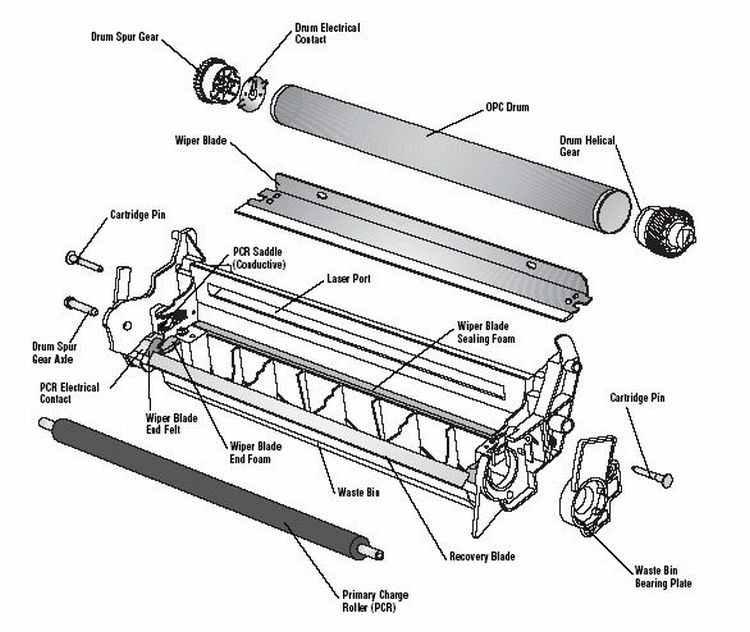
| Waste
Bin Section |
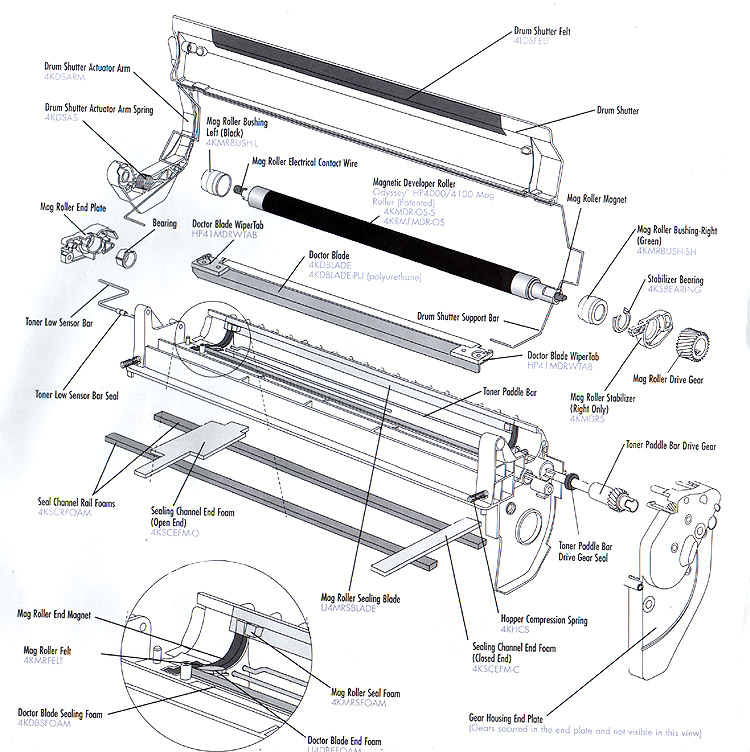
Roller
Housing |
(
Please click on a image to view larger version )
TECHNICAL
Mentioned below in brief is the printing process:
In one of
the stages the primary charge roller places a
uniform negative DC bias voltage on the opc drum surface. The
amount of the negative DC bias placed on the drum is controlled
by the printers intensity setting. This process is called conditioning.
Hence the need to change the primary charge roller every cycle
to give a uniform negative DC bias. Non compliance of the above
might lead to faulty printing
In another
stage the laser beam is fired on to a rotating mirror called the
scanner. As the mirror rotates, the beam reflects into a set of burberry bags outlet
focusing lens. The beam then strikes the opc surface leaving a
latent electrostatic image on the drum. The opc drum
should be mint new, as otherwise image distortion would take place
In secondary
stages the toner image is developed on the drum by the developing
section which contains the toner particle. The toner is held to
the magnetic roller sleeve by the stationery magnet inside the
sleeve and the DC bias voltage supplied by the high voltage power
supply. Critical to note here is that the toner powder
used, should be of the highest quality for proper attraction by
the magnetic sleeve. Also important to note is that the magnetic
sleeve is to be replaced in all cycles due to its critical
function of proper attraction of the toner powder.
In the waste
bin section, the wiper blade performs the all
important function of cleaning the opc drum. If the blade is not
changed, it leads to flip overs and spills leading to dots over
the printout and subsequent printer damage. Hence it is imperative
to change the wiper blade very cycle.
CONCLUSION:
The five critical
components mentioned above are a must for proper functioning of
the cartridge and need to be replaced every cycle.
 [email protected]




 Compatible Laser
Toner Cartridges
Compatible Laser
Toner Cartridges